
























































Share this Post



The Best Shipping Box Strategy for Lower Costs and Safer Deliveries
Shipping boxes often look like a small operational detail, but they quietly influence almost every part of fulfillment. Packing speed, storage space, shipping cost, and product safety are all affected by how boxes are chosen and used. Many businesses don’t notice the problem until order volume grows, and inefficiencies start piling up. At that point, packaging becomes a recurring source of delays, damage, and unnecessary cost.
Most shipping box issues are not caused by a lack of options. They come from inconsistency. Too many box sizes, oversized packaging, weak materials, and unclear rules force people to make decisions on the fly. Without a simple system, packaging becomes reactive instead of predictable, and the same mistakes repeat across every shipment.
Quick Summary
Most shipping box problems come from inconsistency, not limited packaging options. Businesses can reduce costs and prevent damage by standardizing box sizes, resizing or combining boxes, avoiding oversized packaging, securing items properly, matching box strength to weight, and sourcing boxes efficiently. While these practical methods improve fulfillment performance, a true game changer, and often a lifesaver for small businesses managing growth, is adopting smarter automation.
We offer one of the most effective solutions through ClickShip Smart Packaging Solutions, which uses packing optimization algorithms to automatically match orders with packaging based on weight and dimensions, reducing guesswork and improving shipping efficiency. We’ll explore this further later in the article.
The Practical Solutions to Fix Shipping Box Issues
Most shipping box problems can be solved with a small set of practical, repeatable solutions. These work together as a system rather than one-off fixes:
- Frankensteining boxes by combining boxes creatively when needed
- Keeping a set of core standard box sizes
- Avoiding oversized packaging
- Modifying existing boxes before buying new sizes
- Using tools that make box resizing cleaner and easier
- Securing items to prevent movement
- Reusing boxes selectively and carefully
- Finding inexpensive boxes through local marketplaces
- Matching box strength to item weight
- Reinforcing boxes when boxes are combined
- Understanding how box dimensions affect shipping cost
1: Frankensteining Boxes
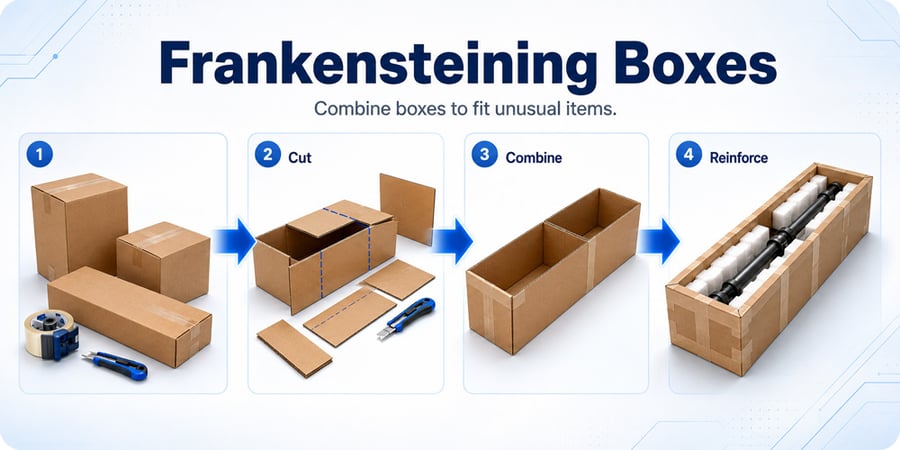
Combine boxes creatively to handle unusual items
Sometimes no standard box fits a product properly. In these cases, combining two or more boxes into a custom shape is a practical solution. This process involves cutting, resizing, and joining box sections, so the final package fits the item more closely.
When done correctly, frankensteining boxes help avoid oversized packaging and eliminate the need for expensive custom boxes. The key is reinforcing all seems, so the modified box remains rigid and secure during handling and transit.
2: Core Box Sizes
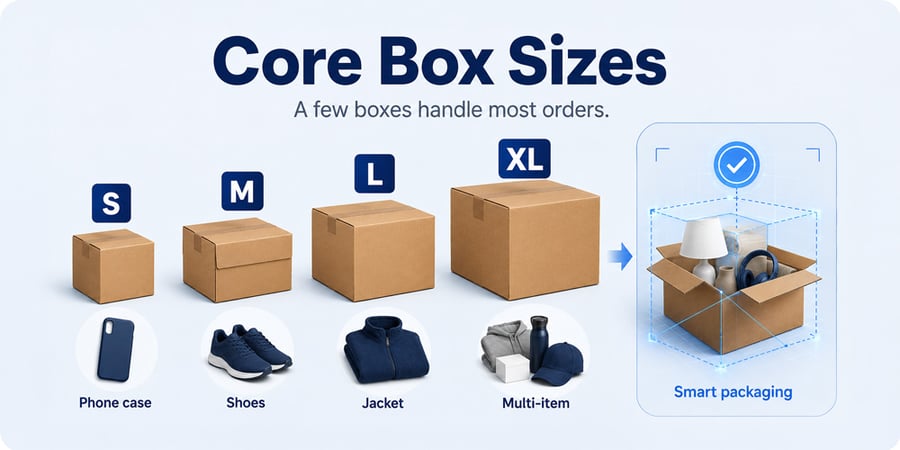
Build a small set of go-to boxes
Using a small set of core box sizes can make packing faster and easier. Instead of stocking too many different box options, sellers can choose a few standard sizes that work for most of their everyday orders.
This approach can work even better with ClickShip Smart Packaging Solutions, which helps match orders with suitable packaging based on weight and dimensions.
Example:
A seller may keep four main box sizes:
Small boxes for phone cases
Medium boxes for shoes
Large boxes for jackets
Extra-large boxes for multi-item orders
For most shipments, the packing team can quickly choose one of these core boxes. If an order has multiple items or unusual dimensions, smart packaging can help identify a better box setup before shipping. This keeps packaging inventory simple while still giving sellers flexibility for more complex orders.
3: Size Waste

Stop using boxes that are larger than necessary
Oversized boxes are one of the most common and expensive packaging mistakes. They require more fillers, increase material usage, and often push shipments into higher pricing tiers. Extra space inside the box also allows items to shift, increasing the risk of damage.
Choosing the smallest appropriate box reduces cost and risk at the same time. Simply controlling box dimensions can significantly lower shipping expenses without changing products or pricing.
4: Smart Resizing
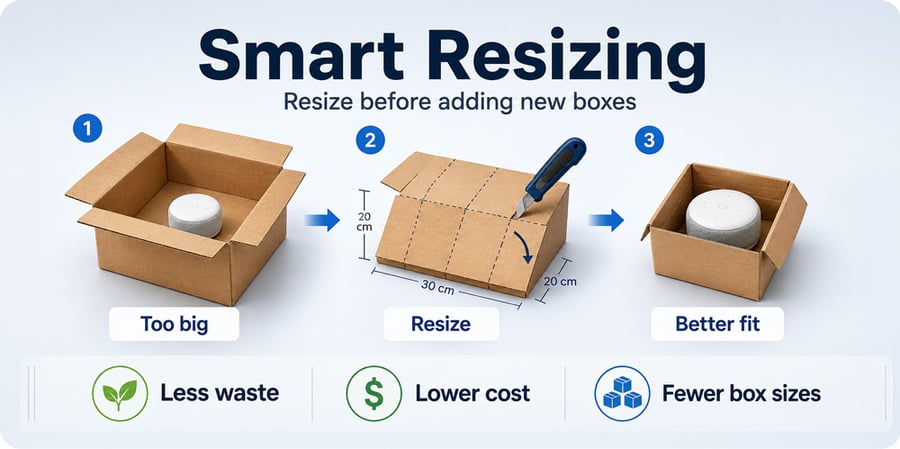
Modify boxes before adding new ones
When an item doesn’t fit well, many businesses respond by adding another box size. In most cases, resizing an existing box is faster, cheaper, and more effective. Trimming a box reduces empty space and improves stability.
Resizing allows a limited box of inventory to handle a wider range of products without increasing complexity.
5: Box Resizer Tools
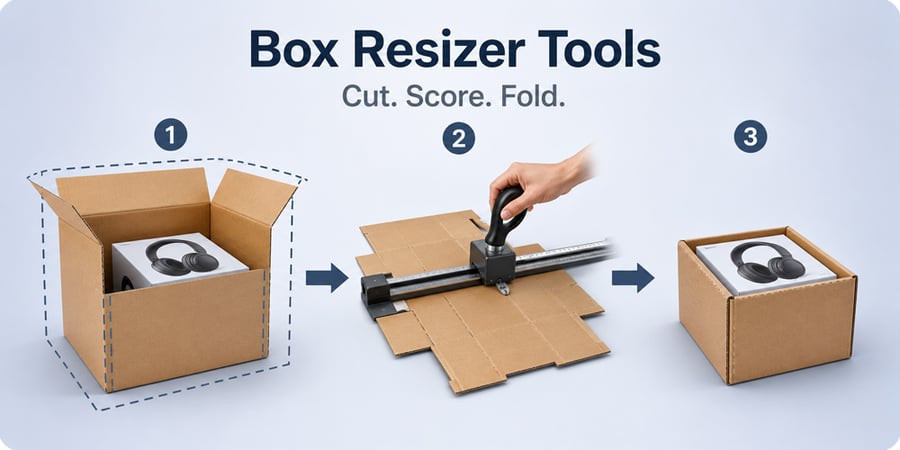
Make resizing faster and cleaner
Resizing boxes regularly becomes much easier with the right tools. Tools that allow both cutting and scoring make it possible to create clean fold lines without weakening the cardboard.
Using a proper box resizer helps create snug-fitting boxes quickly, improves presentation, and keeps modified boxes structurally sound.
6: Shape Flexibility
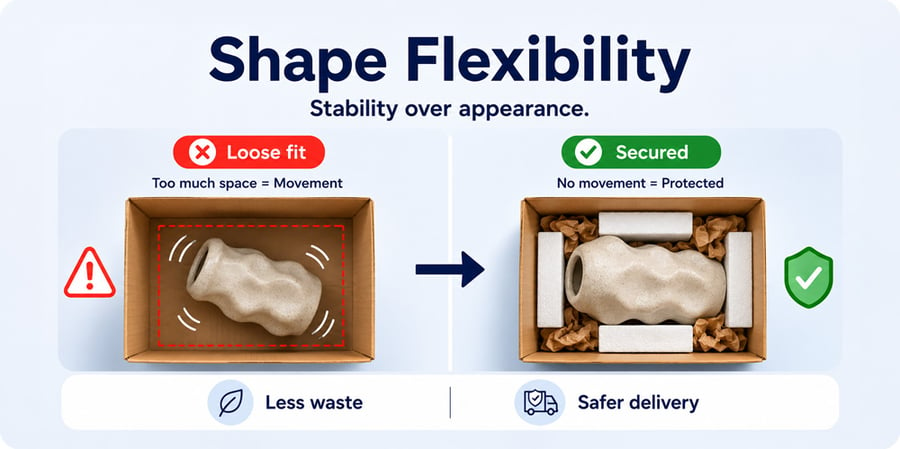
Focus on stability, not appearance
Many products are irregularly shaped. Trying to find a perfectly shaped box often leads to oversized packaging and wasted space.
The goal is not visual perfection. The goal is to prevent movement. An item that is fully secured inside the box will arrive safer than one that looks neat but shifts during transit.
7: Safe Reuse
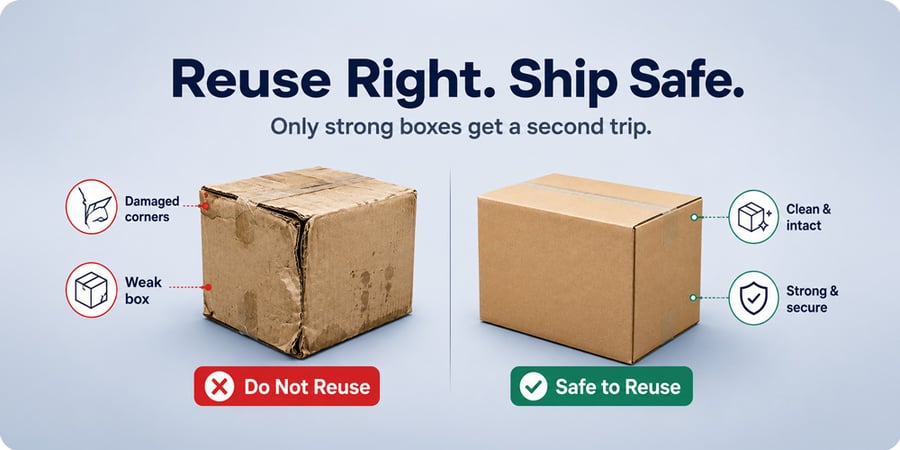
Reuse boxes only when they are reliable
Reusing boxes can reduce costs, but only when done carefully. A reused box must be clean, rigid, and structurally intact. Soft corners, weakened walls, or previous damage reduce reliability.
Consistency matters. Mixing strong and weak boxes in the same process leads to unpredictable results and avoidable losses.
8: Finding Affordable Boxes Locally

Lower costs through community sourcing
Many businesses reduce packaging costs by sourcing boxes locally through community marketplaces, buy-and-sell groups, or surplus listings. These sources often offer unused or lightly used boxes at much lower prices.
This approach is especially helpful for large or uncommon box sizes that would otherwise be expensive to purchase new.
9: Weight Strength
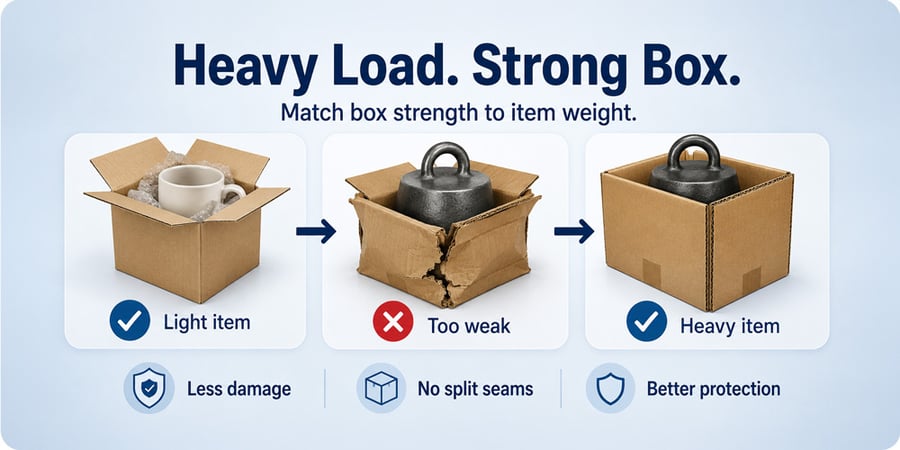
Match box strength to item load
Not all boxes are designed to carry the same weight. Lightweight items can ship safely in thinner cardboard, while heavier products require stronger construction.
A box that flexes under load is more likely to split at seams during lifting or stacking. Matching box strength to item weight prevents repeated damage issues.
10: Box Joining (Combining Boxes)
.jpg?width=900&height=450&name=Box-Joining-(Combining-Boxes).jpg)
Build the box you need
When two or more boxes are taped together to make one package, the connection points become weak spots. These seams take extra stress during lifting, stacking, and shipping, and they can easily split open if they’re not reinforced properly.
To prevent this, all joined seams should be reinforced with extra tape or strapping. Without proper reinforcement, a combined box is usually weaker than a single, properly sized box and is more likely to fail during transit.
Smarter Packaging Decisions with ClickShip Smart Packaging
Choosing the right box strength matters, but as order volume grows, manual packaging decisions slow fulfillment and create inconsistency. ClickShip Smart Packaging removes that friction by using intelligent packing algorithms to automatically match each order with the most suitable packaging based on weight and dimensions. This helps reduce guesswork, control shipping costs, and speed up processing, especially for businesses managing complex or high-volume shipments. Instead of relying only on manual packing rules, you can streamline operations, improve accuracy, and scale fulfillment with confidence using ClickShip’s built-in optimization tools.
Ready to simplify packaging and ship smarter?

Additional Packaging Details That Make a Bigger Difference Than Expected
Cost Impact
Understand how box dimensions affect pricing
Shipping costs are closely tied to box dimensions. Even small increases in length, width, or height can change how a shipment is priced.
Standardizing box sizes allows shipping costs to be estimated accurately and reduces surprises during fulfillment.
How Packaging Affects Storage Space and Organization
Box choices affect storage just as much as shipping. Too many sizes take up unnecessary space and disrupt workflow. Over time, cluttered storage slows packing and increases frustration. Keeping boxes flat until needed and limiting size variety helps maintain order and supports faster daily fulfillment.
Why Consistent Packaging Processes Matter
Effective packaging systems are predictable. When the same steps are followed for every shipment, errors decrease and quality becomes easier to control. Consistency also simplifies training and supports growth as order volume increases.
How Clear Packaging Rules Improve Fulfillment Speed
Unclear packaging rules slow everything down. When packers stop thinking or compare options, fulfillment speed drops. Clear rules remove hesitation and allow orders to move faster with fewer mistakes.
Packaging and Customer Experience
Customers notice packaging quality immediately. Items that arrive damaged, poorly packed, or unnecessarily oversized reduce trust and satisfaction. Well-fitted, secure packaging reinforces professionalism and reduces returns.
Packaging Decisions and Long-Term Costs
Packaging mistakes rarely appear as one-time expenses. They accumulate through higher shipping fees, wasted materials, damaged goods, and extra labor. Standardizing box sizes and controlling empty space lowers long-term operational costs.
Packaging at Scale
As order volume grows, small inefficiencies become major problems. Packaging systems must be simple, repeatable, and easy to scale. Fewer decisions per shipment make growth smoother and more predictable.
The One Rule That Simplifies All Packaging Decisions
Use the smallest strong box that keeps the item completely still. This single rule balances cost, protection, and efficiency and prevents most common packaging mistakes.
Frequently Asked Questions
How many shipping box sizes should a business realistically keep?
Most businesses operate efficiently with three to five standard box sizes. This small range usually covers the majority of products while keeping storage simple and packing decisions fast. Limiting box sizes also improves consistency and reduces mistakes as order volume increases.
Is resizing shipping boxes actually worth the extra time?
Yes, resizing boxes is often worth the effort. Spending a few extra seconds adjusting a box can significantly reduce empty space, lower shipping costs, and improve product stability. Over time, resizing helps prevent damage and reduces the amount of filler needed per shipment.
When should a shipping box never be reused?
A shipping box should never be reused if it has soft corners, torn walls, crushed edges, or any structural weakness. These issues make the box more likely to fail during transit. Reusing weak boxes often leads to damaged items and higher long-term costs.
Can sourcing boxes locally really reduce packaging costs?
Yes, sourcing boxes through local community marketplaces or surplus listings can significantly reduce packaging costs. Many unused or lightly used boxes are available locally at lower prices, especially for larger or uncommon sizes. This approach is particularly helpful for businesses trying to control overhead.
Does adding more fillers solve the problem of oversized boxes?
Fillers can reduce movement, but they do not fully solve the problems caused by oversized boxes. Large boxes still increase shipping fees and material usage. In most cases, choosing or resizing the correct box is more effective than adding extra filler.
What is the most common cause of damage during shipping?
The most common cause of shipping damage is movement inside the box. When items shift during transit, they are more likely to break, scuff, or wear. Preventing movement through proper sizing, padding, and stabilization is critical for safe delivery.
Are stronger shipping boxes always better for all products?
Not always. Box strength should match the weight and fragility of the item being shipped. Using boxes that are too strong for lightweight items increases cost without improving protection. The goal is balance, not overbuilding.
Is combining or “Frankensteining” box a good long-term solution?
Combining boxes can be effective for unusual or oversized items, but it should not be the default approach. Frankensteined boxes require proper reinforcement and careful handling. When used selectively, they offer flexibility without needing custom packaging.
Should shipping boxes be assembled in advance or kept flat?
Keeping boxes flat until needed is usually more efficient. Flat storage saves space, keeps packing areas organized, and allows flexibility. Boxes should only be pre-assembled if storage space allows, and order volume is predictable.
What is the biggest shipping box mistake businesses make?
The most common mistake is using boxes that are larger than necessary and trying to compensate with fillers. This increases shipping costs, wastes materials, and often still allows movement. Choosing the right size or resizing the box is almost always the better solution.

Written by Mehran Kiani
Mehran Kiani is a full-time SEO specialist at Freightcom, the leading shipping solution for businesses in Canada. When Mehran is not working to help businesses with their shipping needs, he enjoys playing soccer, barbecuing, and spending time with his family.