




EU Customs Changes at a Glance
Canadian online sellers have had to face new EU customs costs and product data requirements in 2026. With the next changes est to arrive on November 1, now is the time to take a moment and review your EU pricing and prepare your product catalogue.
|
Date |
What changes |
Who needs to prepare |
|
July 1, 2026 |
Temporary €3 duty for each chargeable customs item |
Eligible consignments with intrinsic value up to €150 |
|
November 1, 2026 |
€2 Union handling fee |
Qualifying distance sales, including those above €150 |
|
November 1, 2026 |
Product identifier requirements |
Qualifying low value distance sales |
Who is affected: Canadian stores and marketplace sellers shipping qualifying orders to customers in the European Union.
Why it matters: Additional import charges affect order profitability and checkout pricing. Incomplete product information also creates a risk of clearance delays.
What to do now: Confirm the requirements for your shipping service, complete your product records and check how import costs appear at checkout.
Use the guide below to assess your costs, protect your margins and prepare a more predictable delivery experience for your EU customers.
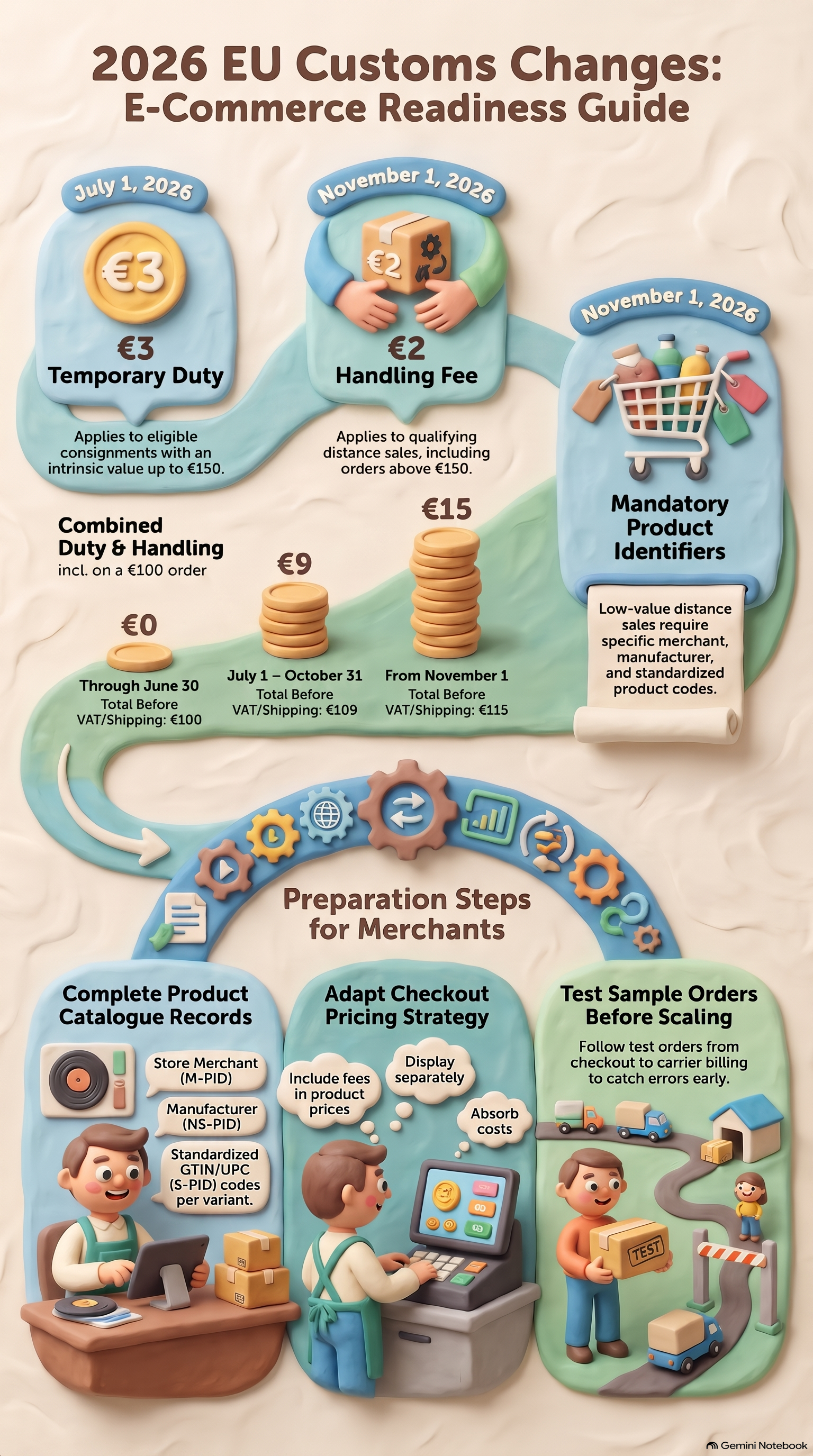
What is Changing for EU Shipments?
The temporary customs duty applies to eligible consignments with an intrinsic value up to €150. Intrinsic value generally means the price of the goods themselves, excluding transport and insurance when those costs appear separately on the invoice. It differs from the final amount a shopper pays at checkout.
The Union handling fee reaches further. It also applies to qualifying distance sales above €150. The new product identifier requirements covered here concern qualifying low-value distance sales.
These changes make it useful to review your EU shipping settings separately from your other international markets. Base your pricing on the destination, products and clearance service you use. A single surcharge for every European order risks charging some shoppers too much while leaving your store to absorb costs on others.
Why Three Products Don’t Always Mean Three Customs Charges
Customs charges depend on how the goods appear on the declaration. A physical unit, a store SKU and a customs declaration line do not always represent the same thing.
For example, one silk blouse and two wool blouses fall into two tariff categories in the EU's published illustration. The temporary duty totals €6, even though the parcel contains three garments.
Use the declaration structure confirmed by your carrier or customs broker when estimating costs. Avoid assuming each item in a cart attracts a separate charge, or a bundle automatically attracts one charge.
For an eligible low value shipment, the two government charges produce the following totals from 1 November. These examples assume the stated number of correctly declared chargeable lines. They exclude VAT, transportation, brokerage and carrier service fees.
|
Chargeable customs lines |
Duty at €3 |
Handling fee at €2 |
Combined charges |
|
1 |
€3 |
€2 |
€5 |
|
2 |
€6 |
€4 |
€10 |
|
3 |
€9 |
€6 |
€15 |
Your final delivery cost depends on the rest of the shipment as well. Keep those additional costs visible when comparing services or setting customer prices.
How the Same Order Costs More Through 2026
Consider a €100 order with three confirmed chargeable customs lines. The comparison below isolates the goods value and the two government charges for an eligible low value shipment. VAT, transportation, brokerage and carrier fees sit outside this example.
|
Cost component |
Through June 30 |
July 1 to October 31 |
From November 1 |
|
Goods value |
€100 |
€100 |
€100 |
|
Temporary duty |
€0 |
€9 |
€9 |
|
Union handling fee |
€0 |
€0 |
€6 |
|
Subtotal before VAT and other costs |
€100 |
€109 |
€115 |
By November, these two charges add €15 to this order before the remaining costs. If your business absorbs the amount, it reduces the money left from the sale. If you recover it from the customer, review the checkout or quotation total and how you explain the charge.
The example assumes the same goods value and declaration structure throughout. Your carrier or broker must confirm the actual chargeable lines and applicable procedure.
Understand the Three Product Identifiers
A product identifier is a code that differentiates the products being sold. Your tariff code classifies the goods for customs. Keep both in your records. A tariff code does not replace the manufacturer reference or barcode.
Start with the three identifier types below. The examples describe the type of information to collect, rather than codes to copy into your catalogue.
|
Identifier |
Example |
General requirement |
Where to look |
|
Merchant PID |
Store or marketplace reference |
Required |
Sales channel product record |
|
Manufacturer PID |
Model or part number |
Required |
Supplier catalogue or packaging |
|
Standardized PID |
GTIN, EAN, UPC or ISBN |
Where one exists |
Manufacturer barcode record |
Verify which merchant reference your sales channel uses before mapping an internal SKU. Request manufacturer references from your supplier and preserve the original value in your product record. Avoid assigning the same model number to different products simply to complete a field.
Where no standardized identifier exists, the declarant uses Y081 as appropriate. An empty field needs a confirmed reporting treatment.
Check the Rules for Your Product Type
Special treatment depends on the applicable commodity code. Have your declarant confirm eligibility for conventional PID reporting.
|
Product group |
Treatment to check |
|
Ordinary manufactured goods |
Merchant and manufacturer PIDs, plus standardized PID where one exists |
|
Specified handmade goods |
Commodity-specific conventional PID reporting |
|
Unprocessed agricultural and perishable goods |
Commodity-specific conventional PID reporting |
|
Antiques, art and collectibles |
Commodity-specific conventional PID reporting |
|
Medical devices |
UDI-DI where applicable |
|
Medicines and OTC products |
Product code AI 01 where applicable |
|
Second-hand, refurbished and print-on-demand goods |
Standard PID requirements |
Use this table to identify which product records need closer review before dispatch. For regulated products, complete the separate product compliance review as well. A customs identifier does not establish permission to sell the goods.
Build a Product Record Your Team is Able to Reuse
Keep the approved merchant reference, supplier model, existing barcode, description, classification, origin and sale value together for each variant. A change to a supplier reference should trigger a review of the connected store and shipping records.
Test size and colour variants, marketplace listings and gift bundles separately. An accurate parent product record does not establish whether every order carries the right variant details. Start with your highest-volume EU products, then complete the remaining catalogue.
Decide How Your Store Will Recover the Additional Cost
There is no single pricing approach suited to every catalogue. Your choice should reflect your margin, your customers and the billing arrangements available through your shipping service.
Including costs in your EU product prices supports a predictable checkout total. A separately displayed import charge gives shoppers a visible breakdown when your checkout and shipping process support the calculation and collection. Absorbing some costs gives you another option for selected products or campaigns with enough margin.
Test each approach against completed orders. Compare the amount your customer pays with the amount your business retains after fulfillment. Include payment fees, packaging, shipping subsidies, expected returns and customer acquisition costs.
Then check the customer promise. If checkout presents an inclusive price, your collection and carrier billing arrangements need to support it. Make clear who pays any remaining charges before the customer places the order.
Choose a Pricing Approach Suited to Your Catalogue
|
Approach |
Useful when |
What to measure |
|
Include costs in EU prices |
You want a predictable checkout total |
Profit by product and destination |
|
Show an import charge at checkout |
Your collection and shipping setup support the calculation |
Checkout completion and billed-versus-collected costs |
|
Absorb selected costs |
A product or campaign has enough margin |
Profit after shipping, returns and acquisition costs |
Run each option against real customer baskets before applying it across the store. Include single-product orders, mixed baskets and discounted bundles. Keep the comparison focused on the money your business retains after the order is complete.
Review Bundles and Free Shipping Offers Through Profit
An increase in average order value helps when the additional sale improves your profit. A discounted accessory adds product and packing costs, and the declaration might require another chargeable line.
Consider an illustrative €60 order leaving €18 after your existing costs, before the two government charges. If your store absorbs €10 in duty and handling fees across two chargeable customs lines, the remaining amount falls to €8. This example holds all other costs constant and excludes any additional VAT effect.
Repeat the calculation for your bestselling EU products and promotions. The result helps you decide where to adjust prices, change a bundle or limit an offer to selected markets.
Apply the same approach to free shipping thresholds. A larger basket needs to generate enough additional profit to cover its extra fulfillment and import costs. Raising the threshold without checking the product mix leaves you guessing about the result.
Keep VAT Collection Connected to Your Shipping Process
The Import One Stop Shop, or IOSS, is a VAT collection arrangement for eligible imported consignments up to €150. Review whether your store or marketplace collects VAT and how the relevant IOSS information reaches the customs declarant securely.
Under IOSS, a handling fee passed to the consumer at the point of sale forms part of the VAT base. Have your tax adviser check the complete checkout calculation before changing your inclusive prices.
Test marketplace orders separately from orders placed directly through your store. Each sales channel needs the correct tax information to reach the shipping submission. One successful order test does not establish whether every integration works the same way.
Test a Few Orders Before Changing Every EU Shipment
Choose a small sample reflecting how your customers shop. Include a single product, a mixed basket, a bundle, a marketplace order and an order near the €150 threshold.
Follow each order from checkout to the final carrier bill. Compare the product record, customs submission and commercial invoice. Record any missing fields, manual corrections or unexpected charges, then fix the cause before increasing volume.
Use the test to settle a few practical questions with your shipping provider. Which product fields are required? How will the goods appear on the declaration? Who receives a request for more information? How are import charges billed, and what happens after a return or refused delivery?
Clear answers give your team a repeatable process and give customers a more reliable delivery promise.
Prepare Your Store in a Practical Sequence
|
When |
Action |
Evidence you are ready |
|
Now |
Complete the product records behind your main EU sales |
Supplier references and variant details match |
|
Before the November change |
Confirm fields, billing and checkout messages |
Carrier requirements and collection arrangements agree |
|
Before expanding volume |
Test representative orders through the full process |
Accepted submissions and explainable invoices |
|
After the first invoices |
Compare charges with your estimate |
Pricing or data corrections reach the next order |
Measure Whether Your EU Orders Still Work for Your Business
Review your results weekly during the initial rollout. Track profit after shipping and import costs alongside checkout completion, customs holds, refused deliveries and import-related customer contacts.
Compare estimated charges with actual invoices. Break the results down by destination, product group and shipping service so you know where to act. For smaller shipment volumes, review individual orders alongside the percentages.
Use the findings to make specific changes. Repair the product record behind repeated clearance questions. Adjust an offer losing margin. Revisit a checkout message creating confusion. Each change should address a problem you have observed in your own orders.
|
Measure |
What to investigate |
Possible response |
|
Profit after fulfillment |
Orders losing margin |
Reprice the product or revise the offer |
|
Checkout completion |
Drop following a pricing change |
Review the total and the explanation |
|
Customs holds |
Repeated products or missing fields |
Repair the product record or transmission |
|
Estimated versus billed costs |
Charges omitted from the estimate |
Update the calculation and collection process |
|
Refusals and customer contacts |
Unexpected costs or unclear delivery terms |
Improve the customer promise and service choice |
EU Shipping Preparation Checklist
Work through this checklist before expanding EU order volume. Use the first shipments and invoices to confirm whether the process works as expected.
Product information
☐ Check every EU product variant for complete merchant and manufacturer references.
☐ Record existing standardized identifiers and confirm the reporting treatment where one is missing.
☐ Match descriptions, tariff classifications, origin information and values across your store and shipping records.
☐ Review marketplace listings, customized products and bundles for missing or mismatched details.
Pricing and checkout
☐ Recalculate EU order profitability using confirmed import charges and shipping costs.
☐ Review bundles, discounts and free shipping thresholds against realistic customer baskets.
☐ Confirm VAT collection for direct store orders and marketplace orders.
☐ Check whether checkout messages clearly explain which charges your customer pays.
Shipping and follow-up
☐ Confirm required fields, billing arrangements and November transition instructions with your shipping provider.
☐ Test a single product, mixed basket, bundle and order near the value threshold.
☐ Assign a contact to answer clearance questions and correct incomplete records.
☐ Set a review of the first invoices, followed by weekly checks of costs, holds and customer feedback.
Frequently Asked Questions
Do I need to buy a barcode for every product?
Start by locating the manufacturer identifiers already associated with your products. The standardized identifier requirement applies where an identifier exists. Confirm the submission requirements for products without one before making changes to your catalogue.
Should I stop selling lower priced products to the EU?
Review profitability by product and destination first. A revised price, a different offer or a more suitable shipping service might preserve a worthwhile sale. Removing a market is a commercial decision best supported by your own order data.
Will a higher free shipping threshold solve the cost increase?
Only if the additional profit from the larger basket exceeds the additional costs. Test the threshold against realistic customer baskets and the way those goods will be declared.
Is IOSS the same as paying every import charge?
IOSS addresses VAT collection for eligible imported consignments. Confirm duty, handling fees and service charges separately when agreeing the complete amount your business or customer will pay.
Do handmade products have a blanket exemption?
Treat the product group table as a prompt for a classification check. Obtain the applicable reporting instructions for your actual goods before removing identifiers from the record.
What should we ask about returned orders?
Request a breakdown of which amounts are recoverable, which remain payable and which documents support any claim. Price the return transportation and handling work separately. A customer refund and recovery of import costs are different processes.
Make Your Next EU Shipping Decision with ClickShip
ClickShip brings connected sales channels, carrier rate comparison, labels and tracking into one shipping workflow. Use your EU review to bring better product information and clearer pricing decisions into the orders you ship every day.
Speak with the ClickShip team about your EU destinations, product mix and delivery goals, and see how ClickShip can keep your business running on either side of the Atlantic.

Official Sources
European Commission: EU Customs Reform
Council of the European Union: Customs duty rules for small parcels
EUR-Lex: Product identifier requirements under Regulation (EU) 2026/1022
European Commission: Guidance on the €3 customs duty and Union handling fee
European Commission: VAT ecommerce explanatory notes
EUR-Lex: Union Customs Code and Union handling fee under Regulation (EU) 2026/2108